Porcelain clues

This summer we found two of them twisted in the marshy grass of the lower pasture. The first was half buried in the ground and after unearthing it, we passed the notched white cylinder among ourselves, taking guesses at what it could be. The second offered clues–it sat wrapped in a length of rusty barbed wire.

“They’re fencing insulators,” my grandfather said when we presented them to him, as triumphant as 5 year-olds with a starfish. He seemed bewildered that we had so many questions. “How old are these?” “How did electric fences work then?” “Were they dangerous?” We asked him if he had installed them when he was a boy, when putting up fencing with his brothers. “Well yes,” he said, “Probably.” And he changed the subject. We stored our discoveries in the junk drawer in the kitchen and forgot about them.

But today on a morning walk I found another, deep in the woods behind the house. This one glinted at me from the cold, frozen earth, its twisted nail still embedded in an old fence post, which was almost was indistinguishable from the fallen, decaying tree branches scattered throughout the forest. A line of barbed wire, each strand twice as thick as modern-day fencing, curled across the ground and crept up the trunk of a small, long-dead tree. There was a horizontal scar on the tree where it had encapsulated the barbed wire over these decades.

I stood beside that scarred tree and imagined my grandfather, my great uncles, my great grandfather standing in this same spot, looking back at the long line of posts they had split and driven into the ground, arguing about where the next post should go, whether the wire was taught enough. Their hands on these trees, on this silly, insignificant piece of porcelain. One of thousands they put up over their lifetimes. “It ain’t no big deal,” my grandfather said, sitting in the shade of the ancient maple trees outside. No, maybe not. But they were once clutched in the hands of my ancestors and so, to me, they are a glimpse–small and fleeting–into this the history of the land, the farm, and, me.
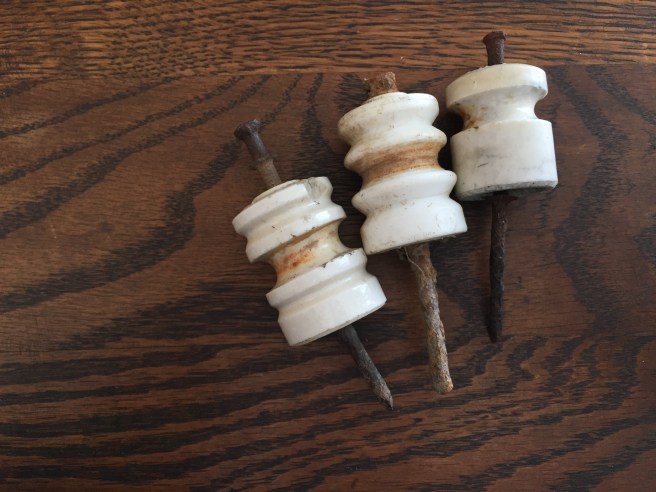
Porcelain insulators

Deer tracks

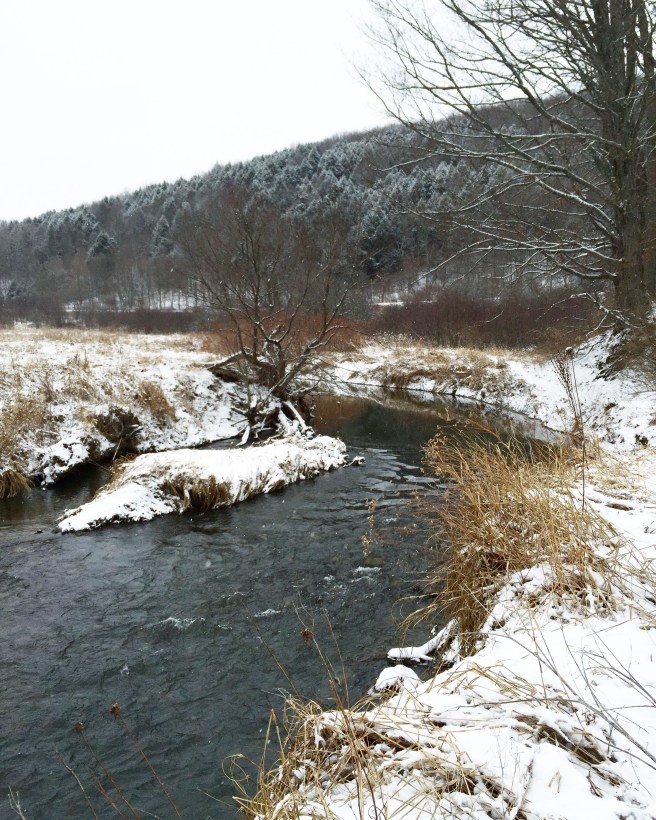
We woke this morning to snow on the ground but not in the air and I know exactly where we will walk. By the time I make it outside with Mac, great puffs are falling from tree branches in the soft wind and floating to the ground, leaving marks in the snow that look very much like deer tracks.

We cross the road at the driveway, walking until we find a narrow, shifting gap in the tall grass. We slide our way down a short, steep embankment and stop to look out over the lower fields. They slope gently away from us, a valley of burnished grass carved by the sharp bends of a serpentine river–Wharton Creek, they call it. Just yesterday this field was a uniform swath of hip-high stalks but today I find what I was looking for: a delicate web of deer paths, outlined in snow.

I head straight to the giant oak by the river, where the the smooth water starts to ripple and sing. This summer Oli laid a metal ladder across it and a few of us tip toed over to explore the marshes and pine forests. The grass was green then, and full of prickers. They skimmed across my bare legs leaving behind swollen stripes of skin. I knew better than to hike in shorts, but later I admired my cuts and bruises–I think that was the day I knew we had to live here.

Now the water is the color of liquid stone and rushes strongly past, skipping over smooth egg-shaped river rocks a few inches below the surface. Mac walks up to the bank and peers down at the water. My stomach flips as I imagine him tumbling over the edge and floating briskly down the river.  “You’re making me nervous,” I say out loud. I’m reminded of something Grandpa told me at Ian’s wedding; that when he was a boy these waters would sometimes rise in an instant, with no warning, stranding a single frantic cow on the other side.

As I stand here now, snowflakes gathering on the tips of my hair, the dark river below, I can imagine that lonely cow on the other side of the bank, calling to her friends.

snowy river

In with the old, out with the new

When we first looked at Far Away Farm with our friends Katie and Will, we knew we’d have to do some work on the house. Not because it was falling down–in fact, the previous owner had almost obsessively invested in the farmhouse’s infrastructure. He also invested in an impressive amount of blue and pink floral wallpaper, and as we walked through each pastel room, we cheerfully tallied up all the things we’d like to change.

The week we closed on the house we blew through the house in a frenzy, tearing layers of wallpaper away, painting trim (formerly beige) bright white, furiously scrubbing woodwork with soap. Afterwards, we sat downstairs, the plaster walls mottled and pocked from 120 years of renovations, the heavy decorative woodwork a deeply unfashionable red mahogany, and I felt no sense of accomplishment. Only melancholy.

Plaster walls

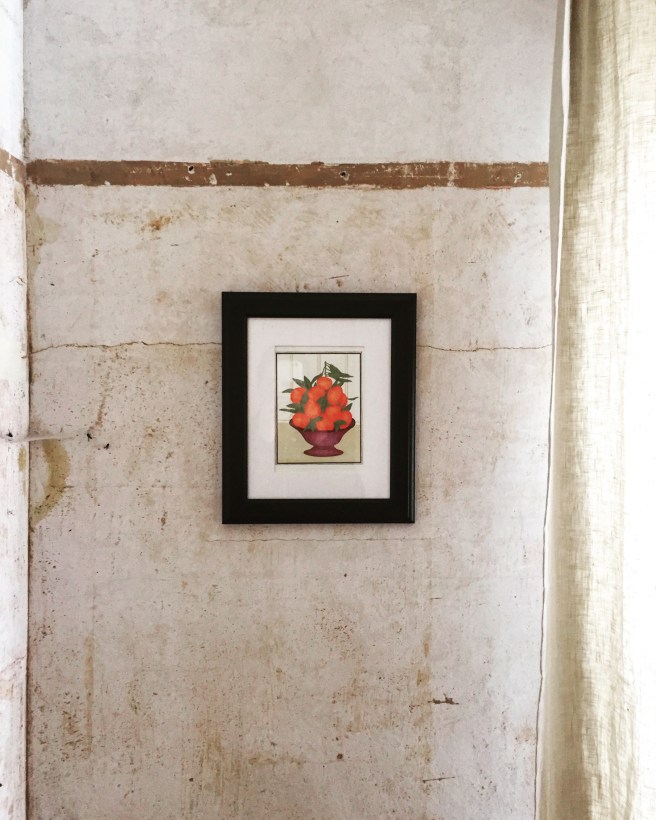
Because where do you go from here? We exposed the house’s original bones and I fell in love. It looked old now. It looked like a place where my great grandparents could have listened to the radio, where my great grandmother could’ve baked on wood fired stove. I couldn’t paint over the horsehair plaster walls, over 120 years old and stained with paint and age. The image of a light, bright catalog ready farmhouse no longer felt right. We were crippled with fear of doing the wrong thing.

Now a year and a half later, surrounded by those same crumbling walls, we think we finally understand what we need to do. We’re slowly making the age of the house visible again by preserving or reviving textures, wood grains, natural wear and tear. And hopefully, by the end, it’ll be what I think it was meant to be–not a pastoral decorative museum, but a real, working farmhouse. The kind of place that, each time you cross the threshold you feel the deep, satisfying thrum of a hard day’s work. Home.

To my grandmother: the land echoes

It’s a bright, clear morning. Funny how after only 3 weeks here, 20 degrees starts to feel like a comfortable temperature for 8am. Today is going to be another warm one–the third day in a row of 55 degree high temperatures in the beginning of February. By the afternoon the very top of the ground will become pliable. But now the ground is silver, each blade of grace and broken stalk crocheted with frost. It crunches softly underfoot, like tissue paper.

Mac and I are starting to weave walking trails around the house in all directions. Today we start in the side meadow, following the road from above. We climb the rolling hills and valleys of the meadow until we reach the tree line at the top of the pasture. From there we walk along the edge of the woods, screened from view by the pine trees, thin and knobby.

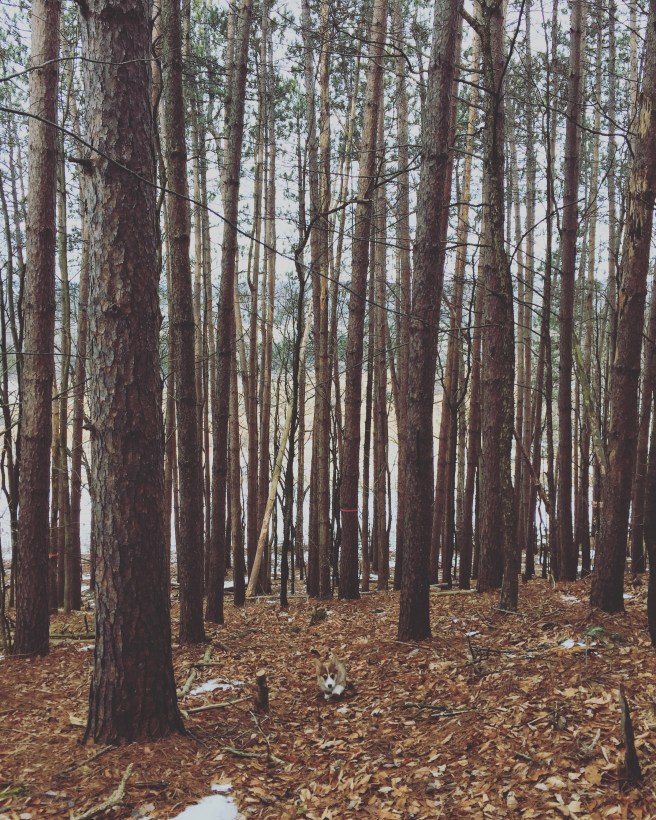
Mac in Pine trees

We reach the spring at the corner of the pasture, where a layer of water has frozen over the ground, so slick that you can tell deer have bounded through and slipped and scrambled to regain their footing. We drop into the woods behind the pond after that, walking straight down the hill–Mac goes tumbling past me. He hasn’t quite figured out how to put the brakes on, but when he reaches the bottom he patiently waits, panting, eyes alight. We walk along a much-used deer path that circles the back pond. When the sun warms this ground it will be muddy, but we glide over the hardened ruts for now, the deep gray blue of the frozen pond to our left. We follow the bank of the pond and cross the stream where water from the upper pond falls to the lower pond. It makes a delicate, crystalline tinkling as it tumbles over icy rocks.

We emerge on the far end of the side lawn, and Mac takes off across the grass, green even now. When we reach the house I sit on the porch steps while Mac runs in figure eights at my feet. He barks once and his tiny puppy voice bounces back at him from the mountain. He jumps and stares. He barks again and the mountain echoes his voice, sending it out across the valley. He does it again and again, and I think about all of the sounds this land has echoed, in my time and in yours.