Welcome!

Hi! I’ve had this blog for over a year, but I’ve been hiding it away, waiting for the time to make it perfect (whatever that means). But 6 months ago we had a baby and I realized that I could die waiting for more time, so here we are! Oli and I have a lot going on at the farm these days–building a horse barn, renovating our Airstream trailer, expanding our garden–and we want to share it with you. We have been so inspired and informed by blogs as we try to live out here, so hopefully some of our posts will help someone in turn.

If you’re one of the very few people who haven’t heard us drone on about how we found our far away farm, check out backstory posts one and two.

Lots of love,

Holly, Oli, Heath, Mac, Cinder, Sushi, Leo, and Stove Mouse

The end of renovations

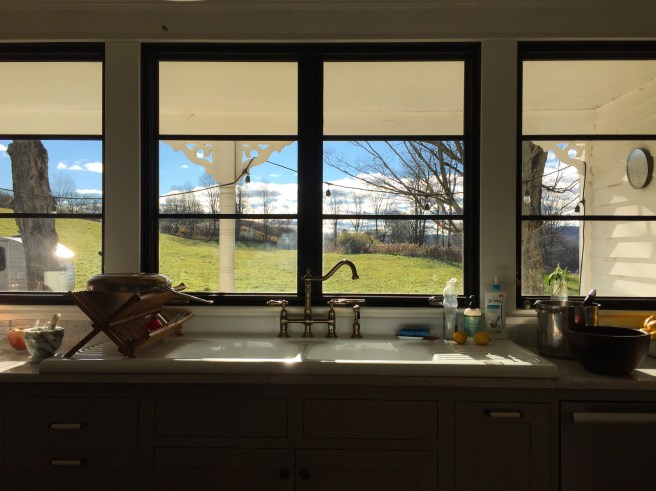
rennovated-farm-kitchen

When our renovations finished, we “moved in” in a matter of hours. In retrospect, I should have waited, photographed the space clean and uncluttered, but oh well. Maybe someday I’ll tidy everything up and photograph it properly, but for now if you’d like to see the work we’ve done there are beautiful professional photographs.

I love this photo more than any professional, tidy photo though. It shows our favorite part of our entire renovation, the windows. Every day, dozens of times a day, we stand at this sink and gaze out over the gently rolling meadow beside the house. The light streams in in the afternoon, and we can’t see anything but nature, and as the grass grows, the leaves fall, and the snow blankets the landscape, we watch it all, still not sure this could be ours.

Our first full summer

Summer on the farm was everything we could have imagined. Warm but never hot (at least by our warm-climate experience), so green it hurts, planting and grilling and napping in the sun. We had an almost nonstop flow of visitors–some from nearby NYC, others from all over the world.

We filled our days with cooking, eating, working in the garden and our nights around the fire, devouring smores and whiskey and deep red wine.  We slept with the windows wide open, the changing sounds of the peepers in the pond marking the passage of time–from the gentle, youthful chirping at the start of summer, to the loud bellows of the mature grown bullfrogs at the end.  Summer doesn’t technically last very long way up here, but the long days and short nights meant we were physically relieved when the temperatures started to cool.

We weren’t sad to see Summer go (our excitement for fall was too great), but we can’t wait to see it next year, when we’ll attack a new set of challenges like a quadrupled garden, a horse barn, and so much more.

Planning and dreaming

The farm was our first house, our first renovation, and to up the pressure, my ancestor’s first ever home. When it came time to start thinking in earnest about what kind of work we’d like to do on the house, our architect urged us to dream big. Imagine all of the things you’d like to do to the house in an ideal world, she said, and let’s draw up a master plan. That way you don’t spend time and money moving a window, for example, only to realize down the road that you wanted to add on anyway.

IMG_0105 3
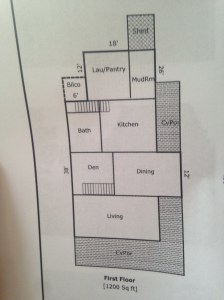
The original layout downstairs

It made sense to Oli and I, and we started to dream in the abstract. “Oooo, I’ve always wanted a stone chimney,” I said. “I’ve always wanted a master suite!” Oli said. We compiled our mile-long wish list and sent it over to the architect to review. I’ll never forgot the panic that washed over me when we first sat down with her and she rolled out the plans. She had done a masterful job of fitting all of our wishes into the new house, but every single wall had been moved, changed, touched. It was an entirely new house. Gone was the dark bedroom on the first floor where my grandfather was born. The kitchen where my Mom sat as a little girl was no longer recognizable, now that it was a hallway. There was a new addition on the back to house the giant kitchen.

IMG_0100 2
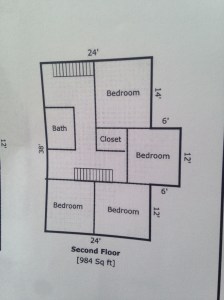
The original layout upstairs


I felt tears and anger well up in the back of my throat. It only fully hit me, in that moment, that I wanted to change as little as possible about this house. I wanted to update it, yes. I wanted it to feel fresh and beautiful and revived. But I didn’t want my “dream farmhouse.” I wanted this farmhouse.

We went back and forth with the architect for months before Oli and I realized that what we really wanted was more of an update and less of a renovation. Little did we know, even “updating” results in tearing a house down to its studs and building it back up. But that would be a lesson we’d learn much, much later.

The back story – Part 2

Screen Shot 2016-02-26 at 1.15.23 PM

We were supposed to meet our friends Katie and Will for brunch one hot summer morning but that didn’t exactly happen. Oli and I were working in New York for a few weeks in between our time in Sydney and San Francisco, and taking advantage of that time to stay in our old neighborhood and catch up with our friends.

We were both putting off leaving the air-conditioned bedroom for the sticky rest of the house (you go, no you go) when I spotted a post from my aunt on Facebook. It’s long gone now, but it said something like, “The original family Munson farm is up for sale! I wish someone in our family could buy it!” There was a link to a real estate ad, one of my favorite kind of links.

The listing wasn’t impressive, but I wanted to see it anyway. “Let’s skip brunch and go see it,” I said to Oli, flopping over on my side. “Oh yeah?” he said, continuing to look at his phone. “Yes! We could rent a car, drive halfway, stay the night, go see iIMG_0057t and then come back. It’ll be a weekend getaway!” I texted Katie and Will to convince them to go with us. The jist of their message was, “Give us 30 minutes to pack, we’ll meet you at the bagel shop.”

We stayed in an Airbnb in the Catskills, had a lovely dinner at a farm to table restaurant in a tiny town, and made our way away from the “cool” part of upstate New York and into the farmland of central New York. By the time we walked through the house and were on our way back to New York, I was convinced we had to buy the place. Now I just had to convince Oli.

The back story – Part 1

Screen Shot 2016-02-26 at 1.15.23 PM

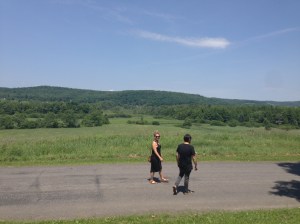
We made a handful of pilgrimages to central New York when I was a kid. I remember endless hours in the car (Dad took out all the seats in the van one year and set up a TV and nintendo) and the overwhelming feeling of well-being when one stands in the sun, in perfect temperature without sweating or shivering. My parents would catch up with various relatives and we’d spend hours and hours outside, emerald-green grass crunching under bare feet, the sun benevolently warming our shoulders. We’d order gigantic, greasy pizzas, and I watched my “northern” cousins sop up the grease on their slices with a napkin (what??).

Inevitably my mom would pack us into the car and make us drive to the “hole in the rock”. It’s exactly what it sounds like–it’s a large boulder on the side of a road that has an inexplicably perfect 3 foot wide hole in it. No one knows why, no one knows how it got there, but we all knew that it was family tradition to pull over on this nameless country road and take a picture with the hole in the rock.

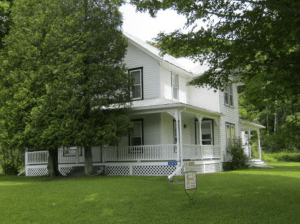
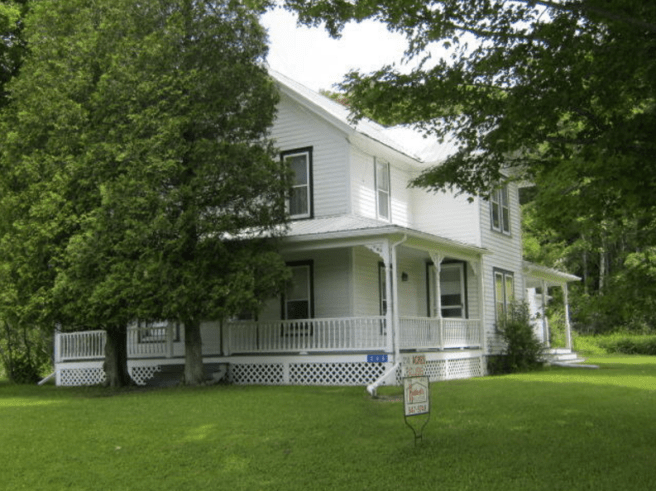
The second stop of this mini pilgrimage was right around the corner, to a road sign that read “Munson Road”. We lined up in front of the sign and smiled for our parents–it wasn’t our last name, but it was my Mom’s last name and as kids I think we thought it was a mere coincidence. After posing with the road sign, the adults would drive down Munson Road and point out a white house sitting just off the road. At this point, we were tired of being treated like monkeys, so we’d make affirmative sounds and barely look out of the window. My memory of the house was of a stately place, surrounded by lush trees, the shaded yard around it looking tended to, but lonely.

Read pt 2 –>

Bye bye 80’s!

When we first walked through the farmhouse, before we decided to buy it, we knew it would need updating. The house was dim and muted, covered in floral wallpaper and wall to wall brown carpets. There were cracked pull-down shades in every window, and more linoleum than I’d seen since my childhood home.

But as we rolled up the carpets and ripped down the shades, we realized that the house had beautiful bones–big windows, perfectly preserved wooden floors and elaborate trim. The only parts of the house that really needed updating were parts that had already been updated–the bathrooms, the kitchen and the laundry room. The rest of the house was perfect, if still covered in flowers and beige trim paint.

The brave architect mother of a good friend helped us work through many of our dreams and questions. We found, through all stages of the renovation (planning, hiring, and execution), it was neither has hard nor as easy as we thought. I know, it makes no sense–but you’ll see what I mean.


Porcelain clues

This summer we found two of them twisted in the marshy grass of the lower pasture. The first was half buried in the ground and after unearthing it, we passed the notched white cylinder among ourselves, taking guesses at what it could be. The second offered clues–it sat wrapped in a length of rusty barbed wire.

“They’re fencing insulators,” my grandfather said when we presented them to him, as triumphant as 5 year-olds with a starfish. He seemed bewildered that we had so many questions. “How old are these?” “How did electric fences work then?” “Were they dangerous?” We asked him if he had installed them when he was a boy, when putting up fencing with his brothers. “Well yes,” he said, “Probably.” And he changed the subject. We stored our discoveries in the junk drawer in the kitchen and forgot about them.

But today on a morning walk I found another, deep in the woods behind the house. This one glinted at me from the cold, frozen earth, its twisted nail still embedded in an old fence post, which was almost was indistinguishable from the fallen, decaying tree branches scattered throughout the forest. A line of barbed wire, each strand twice as thick as modern-day fencing, curled across the ground and crept up the trunk of a small, long-dead tree. There was a horizontal scar on the tree where it had encapsulated the barbed wire over these decades.

I stood beside that scarred tree and imagined my grandfather, my great uncles, my great grandfather standing in this same spot, looking back at the long line of posts they had split and driven into the ground, arguing about where the next post should go, whether the wire was taught enough. Their hands on these trees, on this silly, insignificant piece of porcelain. One of thousands they put up over their lifetimes. “It ain’t no big deal,” my grandfather said, sitting in the shade of the ancient maple trees outside. No, maybe not. But they were once clutched in the hands of my ancestors and so, to me, they are a glimpse–small and fleeting–into this the history of the land, the farm, and, me.
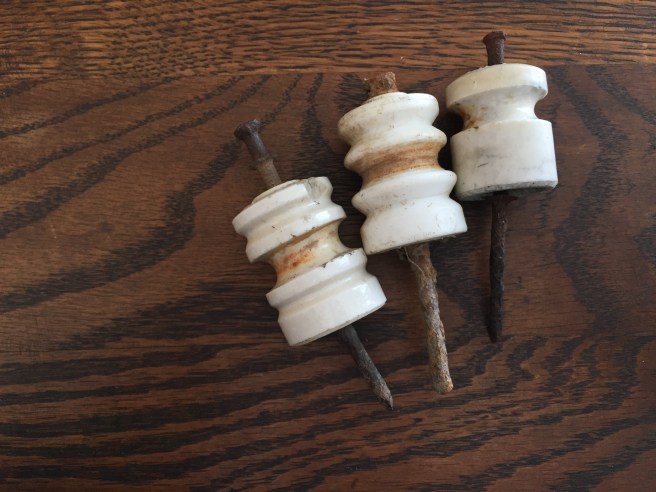
Porcelain insulators

Deer tracks

We woke this morning to snow on the ground but not in the air and I know exactly where we will walk. By the time I make it outside with Mac, great puffs are falling from tree branches in the soft wind and floating to the ground, leaving marks in the snow that look very much like deer tracks.

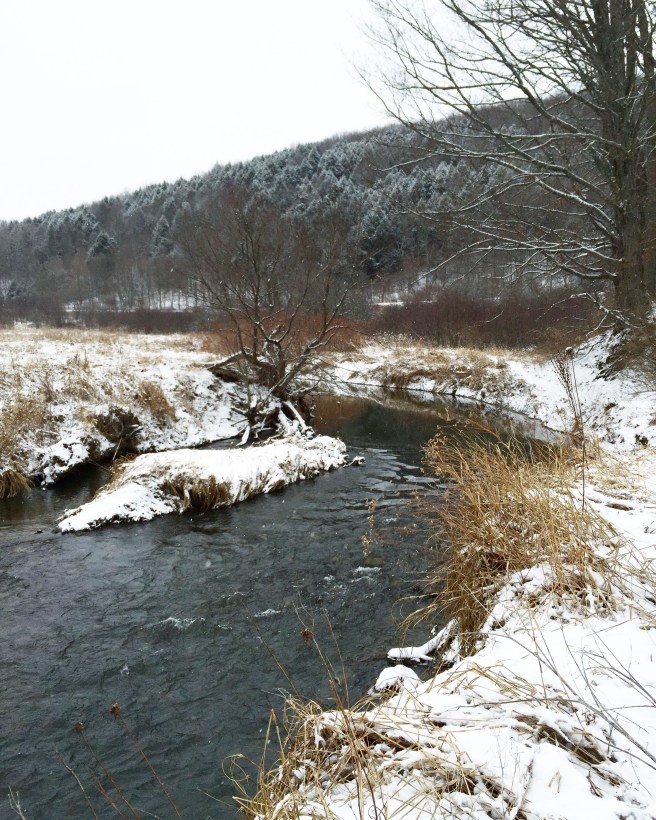
We cross the road at the driveway, walking until we find a narrow, shifting gap in the tall grass. We slide our way down a short, steep embankment and stop to look out over the lower fields. They slope gently away from us, a valley of burnished grass carved by the sharp bends of a serpentine river–Wharton Creek, they call it. Just yesterday this field was a uniform swath of hip-high stalks but today I find what I was looking for: a delicate web of deer paths, outlined in snow.

I head straight to the giant oak by the river, where the the smooth water starts to ripple and sing. This summer Oli laid a metal ladder across it and a few of us tip toed over to explore the marshes and pine forests. The grass was green then, and full of prickers. They skimmed across my bare legs leaving behind swollen stripes of skin. I knew better than to hike in shorts, but later I admired my cuts and bruises–I think that was the day I knew we had to live here.

Now the water is the color of liquid stone and rushes strongly past, skipping over smooth egg-shaped river rocks a few inches below the surface. Mac walks up to the bank and peers down at the water. My stomach flips as I imagine him tumbling over the edge and floating briskly down the river.  “You’re making me nervous,” I say out loud. I’m reminded of something Grandpa told me at Ian’s wedding; that when he was a boy these waters would sometimes rise in an instant, with no warning, stranding a single frantic cow on the other side.

As I stand here now, snowflakes gathering on the tips of my hair, the dark river below, I can imagine that lonely cow on the other side of the bank, calling to her friends.

snowy river

In with the old, out with the new

When we first looked at Far Away Farm with our friends Katie and Will, we knew we’d have to do some work on the house. Not because it was falling down–in fact, the previous owner had almost obsessively invested in the farmhouse’s infrastructure. He also invested in an impressive amount of blue and pink floral wallpaper, and as we walked through each pastel room, we cheerfully tallied up all the things we’d like to change.

The week we closed on the house we blew through the house in a frenzy, tearing layers of wallpaper away, painting trim (formerly beige) bright white, furiously scrubbing woodwork with soap. Afterwards, we sat downstairs, the plaster walls mottled and pocked from 120 years of renovations, the heavy decorative woodwork a deeply unfashionable red mahogany, and I felt no sense of accomplishment. Only melancholy.

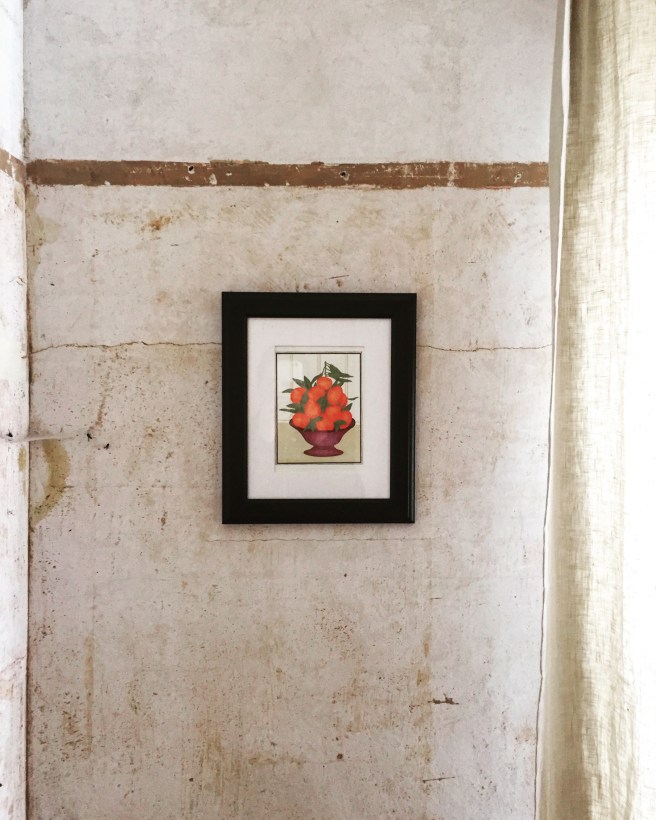
Plaster walls

Because where do you go from here? We exposed the house’s original bones and I fell in love. It looked old now. It looked like a place where my great grandparents could have listened to the radio, where my great grandmother could’ve baked on wood fired stove. I couldn’t paint over the horsehair plaster walls, over 120 years old and stained with paint and age. The image of a light, bright catalog ready farmhouse no longer felt right. We were crippled with fear of doing the wrong thing.

Now a year and a half later, surrounded by those same crumbling walls, we think we finally understand what we need to do. We’re slowly making the age of the house visible again by preserving or reviving textures, wood grains, natural wear and tear. And hopefully, by the end, it’ll be what I think it was meant to be–not a pastoral decorative museum, but a real, working farmhouse. The kind of place that, each time you cross the threshold you feel the deep, satisfying thrum of a hard day’s work. Home.