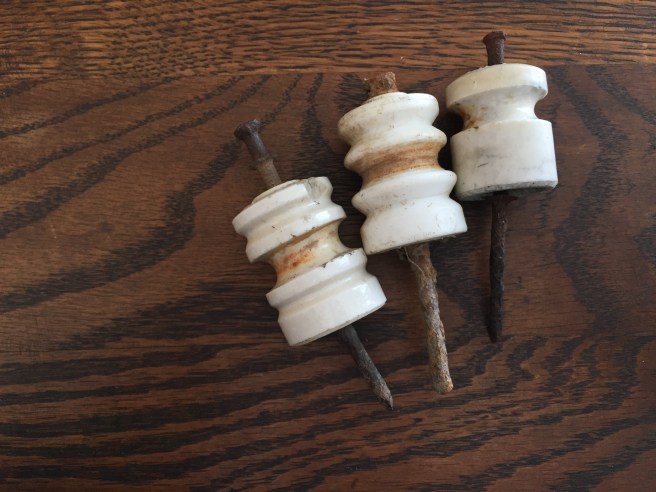
This summer we found two of them twisted in the marshy grass of the lower pasture. The first was half buried in the ground and after unearthing it, we passed the notched white cylinder among ourselves, taking guesses at what it could be. The second offered clues–it sat wrapped in a length of rusty barbed wire.
“They’re fencing insulators,” my grandfather said when we presented them to him, as triumphant as 5 year-olds with a starfish. He seemed bewildered that we had so many questions. “How old are these?” “How did electric fences work then?” “Were they dangerous?” We asked him if he had installed them when he was a boy, when putting up fencing with his brothers. “Well yes,” he said, “Probably.” And he changed the subject. We stored our discoveries in the junk drawer in the kitchen and forgot about them.
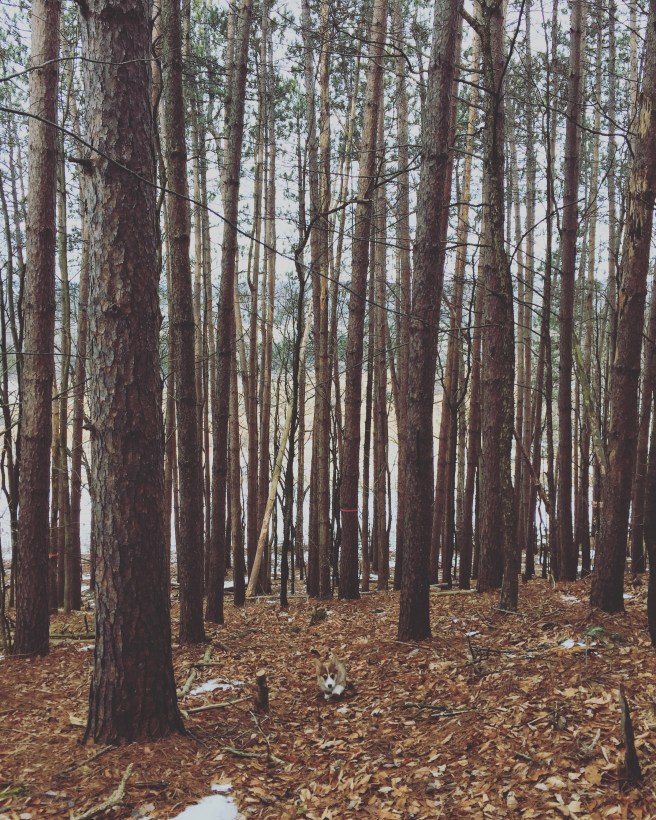
But today on a morning walk I found another, deep in the woods behind the house. This one glinted at me from the cold, frozen earth, its twisted nail still embedded in an old fence post, which was almost was indistinguishable from the fallen, decaying tree branches scattered throughout the forest. A line of barbed wire, each strand twice as thick as modern-day fencing, curled across the ground and crept up the trunk of a small, long-dead tree. There was a horizontal scar on the tree where it had encapsulated the barbed wire over these decades.
I stood beside that scarred tree and imagined my grandfather, my great uncles, my great grandfather standing in this same spot, looking back at the long line of posts they had split and driven into the ground, arguing about where the next post should go, whether the wire was taught enough. Their hands on these trees, on this silly, insignificant piece of porcelain. One of thousands they put up over their lifetimes. “It ain’t no big deal,” my grandfather said, sitting in the shade of the ancient maple trees outside. No, maybe not. But they were once clutched in the hands of my ancestors and so, to me, they are a glimpse–small and fleeting–into this the history of the land, the farm, and, me.
 a far away farm